This section features collective volumes and edited books produced within the E-MIMIC project, offering in-depth insights into inclusive communication, natural language processing, and human-centered AI.
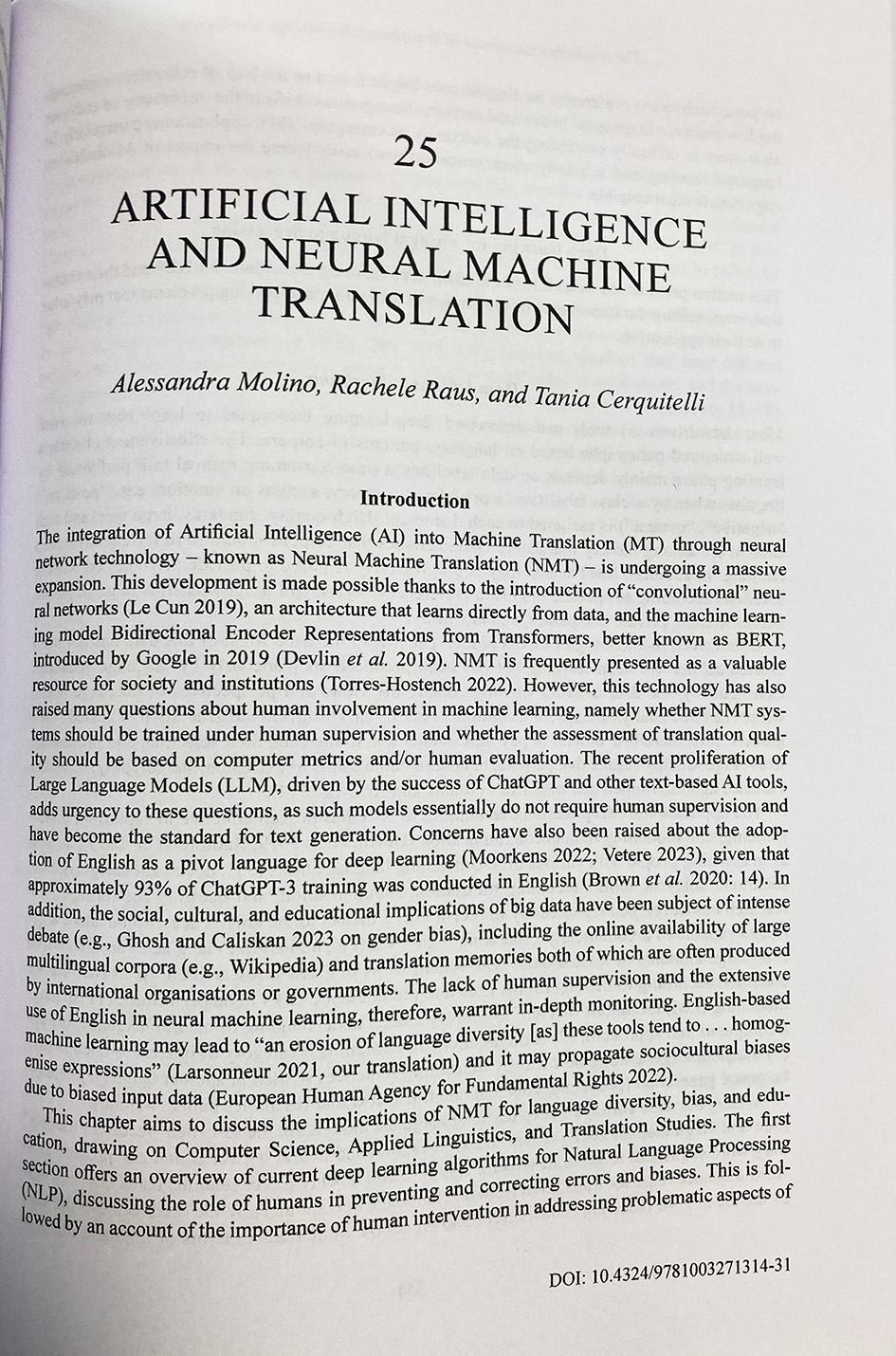
Molino A., Raus R., Cerquitelli T. Artificial intelligence and neural machine translation. 2025
Abstract
This chapter examines the linguistic, social, and educational implications of integrating deep learning into Machine Translation (MT) through neural network technology. Neural Machine Translation (NMT) is widely regarded as a valuable tool for society and institutions. However, it raises important questions about human involvement in machine learning, particularly with regard to the supervision of NMT systems and the evaluation of translation quality. The recent proliferation of Large Language Models (LLMs), such as GPT-4, which rely heavily on English-centric training data, further complicates these issues by potentially reinforcing language homogenisation and socio-cultural bias. This chapter explores how the prevalence of such training data in deep learning and the lack of human supervision in NMT training could affect linguistic diversity and perpetuate bias. It first outlines current deep learning algorithms in Natural Language Processing (NLP) and the importance of human intervention to mitigate errors and bias. The chapter then addresses the need for more inclusive language corpora to ensure representation of low-resource languages. Finally, it highlights the critical role of end-user awareness in the evaluation of NMT applications, especially in contexts such as language learning and academic communication, where the impact of AI on human cognition is significant.
Chapter 25 in The Routledge Handbook of Translation Technology and Society, edited by Stefan Baumgarten, Michael Tieber, Routledge 2025, pp 353–367 – ISBN: 9781032221427
Raus, Rachele (Supervisor) 2025
This volume (with contributions in Italian, French, and English) is the result of a collective reflection by authors from diverse academic backgrounds who have engaged in a shared inquiry into the themes of inclusion, natural language processing, and generative artificial intelligence. The work is situated within the framework of the nationally significant research project (PRIN2022), Empowering Multilingual Inclusive Communication (E-MIMIC), funded under the Italian National Recovery and Resilience Plan and coordinated by the Politecnico di Torino in partnership with the University of Bologna and the University of Rome Tor Vergata.
In the era of artificial intelligence, issues such as inclusion and language acquire heightened relevance due to the linguistic, social, political, and broader implications that AI-supported technologies may have for fostering a just society that respects multilingualism and all forms of diversity.
DOI: https://doi.org/10.5281/zenodo.15584544https://doi.org/10.5281/zenodo.15584544