
The video shows how the AI tool analyzes the entered sentences, checking their inclusivity and suggesting more inclusive reformulations when necessary
Release 2025
The visual identity humanizes technology with a symbolic text cloud to promote inclusive, accessible, mindful, and barrier-free communication
Release 2025
Our Approach
Methodology and Application scenario
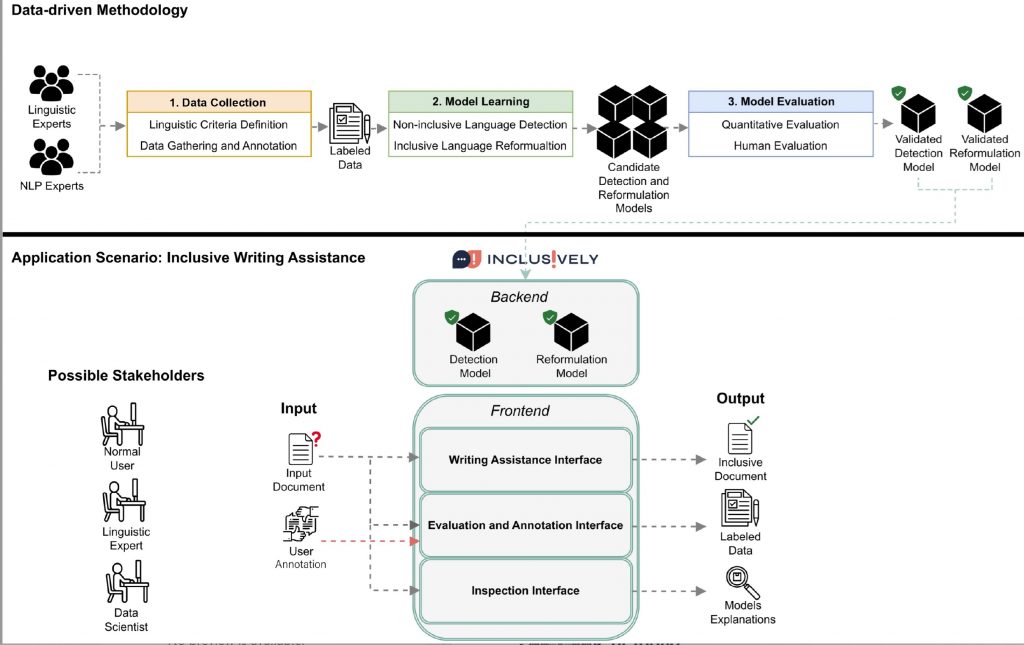
The data-driven methodology to model inclusive language consists of three steps. (1) Data collection: linguistic experts defined the linguistic criteria to model inclusive language, and gathered and annotated a corpus of Italian formal documents to produce a labeled dataset; (2) Model learning: we trained transformer-based classifiers and sequence-to-sequence models to detect and rephrase non-inclusive language; and (3) Model evaluation: we perform quantitative and human validation of the trained models. We employed the best-performing models in the writing assistance tool, namely Inclusively. The tool presents three interfaces: (i) Writing assistance interface where normal users can input a formal document, and the tool identifies and reformulates segments of text that lack inclusivity; (ii) Evaluation and annotation interface where linguistic experts can manually provide additional annotations and feedback for further system refinement; and (iii) Inspection interface which provides end-users with explanations of the models’ outputs.